Tax Deed Auctions by State: A 15-State Reference Guide for Investors
James K. Quigg
Author, Tax Deed Investing Guide
Why State Laws Matter So Much
There is no federal law governing tax deed sales. Every state has its own statutes, procedures, and protections. What this means for investors is that you cannot learn one system and apply it nationwide. The rules change — sometimes dramatically — at every state line.
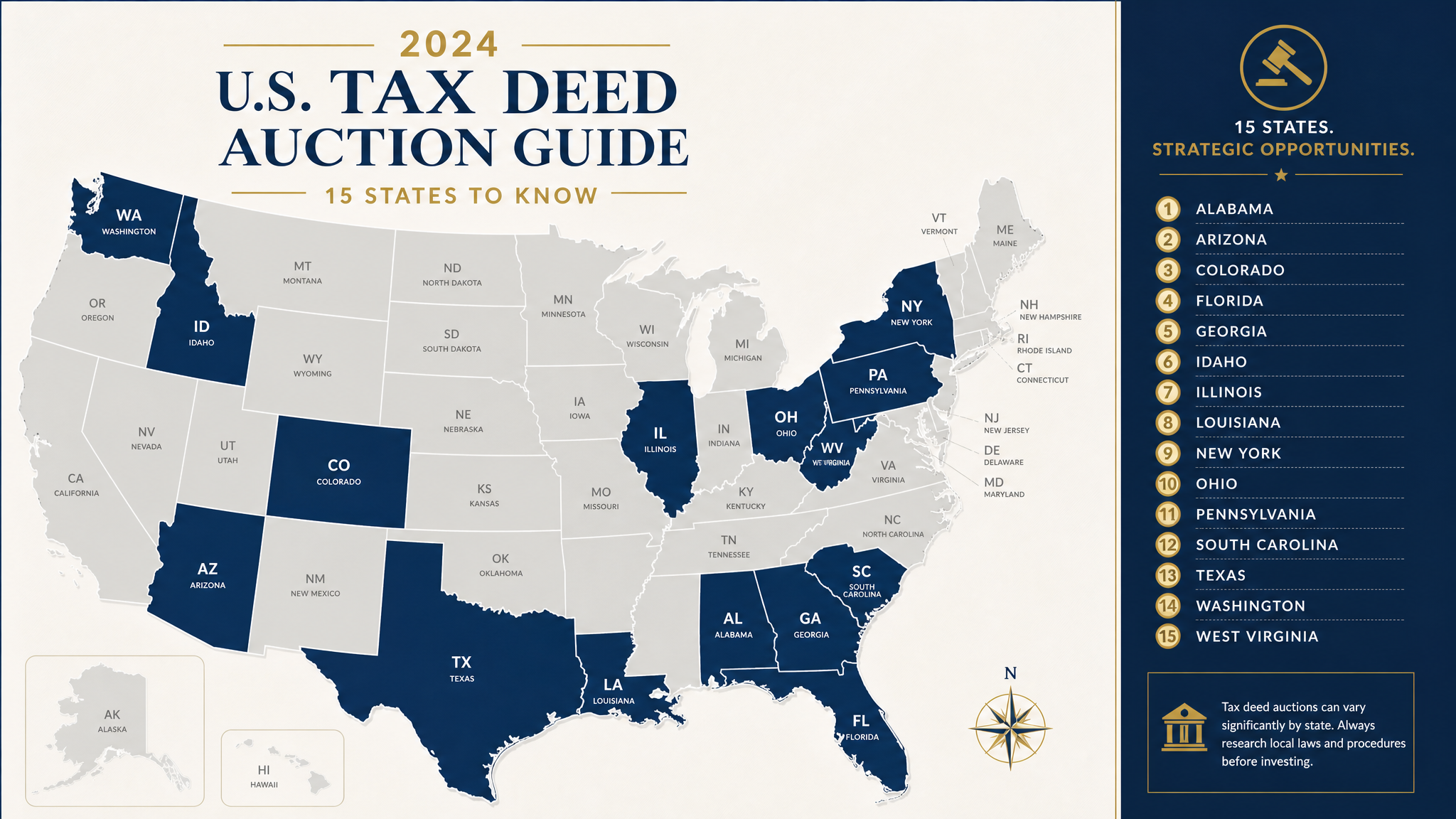
Here is a practical reference for the 15 most active tax deed investing states.
Pure Tax Deed States
These states sell the property outright at auction. The buyer receives a deed.
Florida
- Auction format: Online auctions through county-run platforms
- Redemption period: None for tax deeds (but there is a 2-year redemption for tax certificates)
- Key rule: Florida has a "right of surplus" — excess bid amounts go to the former owner
- Due diligence note: Unlike a genuine super-lien state, Florida law generally treats a tax deed as extinguishing the prior owner's unpaid HOA/COA assessments (the association's claim shifts to any surplus sale proceeds under Fla. Stat. Ch. 197). Do not assume 12 months of assessments survive — confirm the current status with counsel
- Investor tip: Florida is one of the most active tax deed markets in the country. Competition is high, which means margins are thinner
Texas
- Auction format: In-person auctions at the county courthouse, first Tuesday of each month
- Redemption period: 180 days for non-homestead, non-agricultural property; 2 years for a residence homestead, agricultural-use land, or a mineral interest (Tex. Tax Code §34.21)
- Key rule: Texas has one of the strongest redemption rights in the country. Homestead owners can redeem by paying you 125% of your total investment
- Due diligence note: Texas tax deeds come with a statutory warranty only against the "act of the seller" (the taxing authority)
- Investor tip: The 2-year homestead redemption period means your capital is tied up. Factor this into your holding cost calculations
Georgia
- Auction format: In-person auctions at county courthouse steps, first Tuesday of the month
- Redemption period: at least 12 months — after 12 months the purchaser may begin the statutory barment process, but the owner's right to redeem continues until it is properly barred (O.C.G.A. §48-4-40 et seq.)
- Key rule: To redeem, the former owner must pay the redemption price set by statute (the amount paid at the sale plus the statutory premium and certain costs)
- Due diligence note: Georgia requires "barment and foreclosure of the right of redemption" to fully clear title
- Investor tip: Georgia is popular because auction competition is moderate and property values in metro Atlanta suburbs create strong margins
Pennsylvania
- Auction format: Varies by county — some online, some in-person
- Redemption period: None after judicial sale (but a 9-month window for repository sales)
- Key rule: Pennsylvania has two types of tax sales — upset sales and judicial sales. Only judicial sales extinguish liens
- Due diligence note: Always confirm which type of sale you are attending. Upset sales do NOT extinguish liens
- Investor tip: Judicial sales provide cleaner title but happen less frequently
Michigan
- Auction format: Online and in-person, managed by county treasurers
- Redemption period: None after the foreclosure auction (redemption occurs before the sale)
- Key rule: Michigan uses a unique foreclosure process where the county takes ownership first, then sells
- Due diligence note: The Rafaeli Supreme Court decision (2023) strengthened former owners' rights to surplus proceeds
- Investor tip: Michigan properties are often available at very low prices, but many have significant deferred maintenance
Redeemable Deed States
These states issue a deed, but the former owner has post-sale redemption rights.
Alabama
- Auction format: Online auctions through GovEase and similar platforms
- Redemption period: 3 years
- Key rule: The former owner can redeem by paying the bid amount plus 12% per year
- Due diligence note: The 3-year redemption period is one of the longest in the country
- Investor tip: Alabama can be profitable if you factor in the statutory 12% annual interest during the redemption period — but that interest is only paid if the owner actually redeems
Tennessee
- Auction format: In-person at county courthouse
- Redemption period: 1 year
- Key rule: Redemption requires payment of bid amount plus 10%
- Due diligence note: Tennessee requires you to file a "Complaint for Confirmation" after the redemption period expires
- Investor tip: The confirmation process adds legal costs but provides strong title protection
Colorado
- Auction format: County-run sales, many now online
- Redemption period: Varies — typically 3 years for residential (reduced to 1 year for vacant land)
- Key rule: Colorado is technically a tax lien state first, but unredeemed liens convert to tax deeds
- Due diligence note: The lien-to-deed conversion process can take 3+ years
- Investor tip: Colorado's strong property values, especially along the Front Range, make this a high-value market
Hybrid and Notable States
California
- Auction format: Online and in-person auctions managed by county tax collectors
- Redemption period: None for tax deed sales (but properties go through a 5-year redemption window before the sale)
- Key rule: California has strict noticing requirements — sales with defective notice can be voided
- Due diligence note: Environmental liability is particularly significant in California due to state-level environmental laws
- Investor tip: California property values mean even small margins generate significant dollar returns
Nevada
- Auction format: Online auctions through county-run platforms
- Redemption period: None (but there is a 2-year right for homestead occupants in some counties)
- Key rule: Nevada grants HOAs a limited super-priority lien over other liens (NRS 116.3116); whether any HOA balance survives a tax sale specifically depends on lien priority and notice in that proceeding — confirm the statute and the specific facts before bidding
- Due diligence note: Always check for HOA liens — Nevada super lien amounts can be substantial
Arkansas
- Auction format: Online through the Commissioner of State Lands
- Redemption period: None after the sale
- Key rule: Arkansas uses a unique state-level auction system rather than county-by-county sales
- Due diligence note: Arkansas properties at auction are often rural and may have limited market demand
Ohio
- Auction format: Varies by county — both in-person and online
- Redemption period: None after forfeiture sale
- Key rule: Ohio has both sheriff sales and auditor sales — different rules for each
- Due diligence note: Ohio's industrial history means environmental due diligence is critical, especially in urban areas
Indiana
- Auction format: County-run online auctions
- Redemption period: 1 year (reduced to 120 days for vacant properties)
- Key rule: Indiana requires a petition process after redemption period expires
- Due diligence note: Indiana allows tax deed buyers to recover property improvements made during the redemption period
Washington
- Auction format: County-run auctions, increasingly online
- Redemption period: None after the foreclosure deed
- Key rule: Washington uses a judicial foreclosure process for tax delinquent properties
- Due diligence note: Washington's high property values in the western part of the state create strong margins, but competition is intense
North Carolina
- Auction format: In-person at county courthouse
- Redemption period: None after upset bid period (10 days)
- Key rule: North Carolina has a unique "upset bid" process where anyone can outbid the winning bidder within 10 days
- Due diligence note: The upset bid process can significantly increase final prices
Key Takeaways for Multi-State Investors
- Always research state-specific laws before investing in a new state
- Redemption periods dramatically affect your holding costs and return timelines
- Auction formats are increasingly moving online, expanding geographic access for investors
- Lien survival rules vary by state — what survives in Florida may not survive in Texas
- Environmental risk varies by state-level regulation in addition to federal CERCLA requirements
- Professional title examination is non-negotiable regardless of state — every market has unique risks
Sources & Primary References
Legal statements in this article are grounded in the primary sources below. Statutes and agency rules change — always confirm the current text with the official source and, for a specific property, consult a licensed attorney or title professional.
- Texas Tax Code, Chapter 34 (Tax Sales & Redemption)
- Florida Statutes, Chapter 197 (Tax Collections, Sales & Liens)
- Official Code of Georgia Annotated, Title 48 (Georgia General Assembly)
Reviewed by James K. Quigg. Spotted an error? Report it here.
Last reviewed August 9, 2026Free 7-Document Due Diligence Bundle
Get the printable checklists, worksheets, and reference guides mentioned in this article — completely free.
Want the Complete System?
This article covers one piece of the puzzle. The book gives you the entire due diligence system — 163 pages of practical due diligence guidance.
Get the Book