The Maximum Bid Formula: How to Set Your Ceiling at Tax Deed Auctions
James K. Quigg
Author, Tax Deed Investing Guide
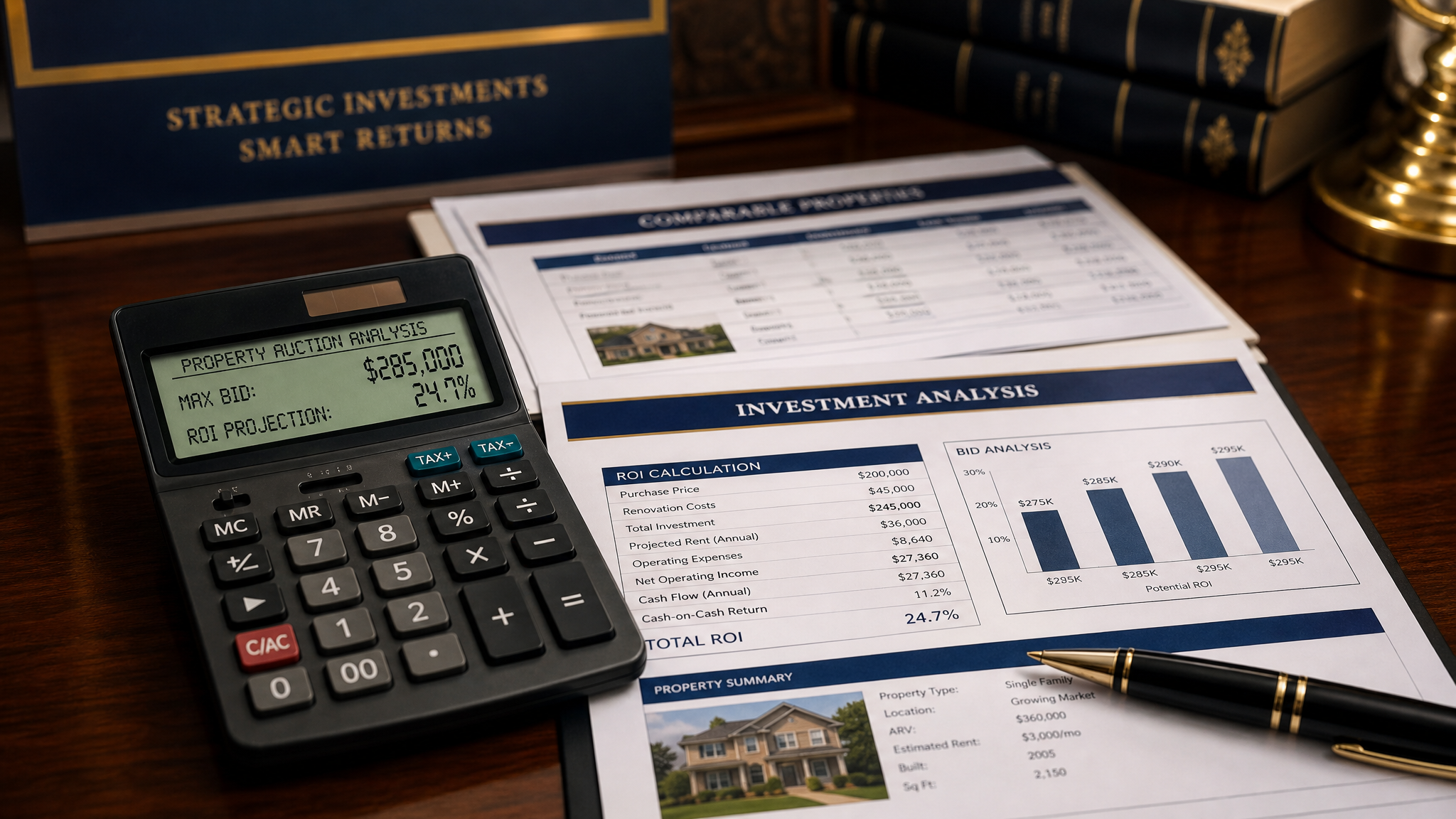
Why You Need a Maximum Bid
Auction fever is real. It is common for bidders to push to $80,000 on a property worth $90,000, leaving zero margin for the $5,000+ in quiet title costs, $3,000 in back HOA dues, and $15,000 in repairs they did not account for. On paper such a deal looks like a $10,000 profit; in a scenario like that (illustrative figures) it becomes a $13,000 loss.
A maximum bid formula removes emotion from the equation. You calculate your ceiling before the auction, and you walk away if bidding exceeds it. Period.
The Formula
Here is the core formula I recommend:
Maximum Bid = ARV × 0.70 − Repair Costs − Surviving Liens − Quiet Title Costs − Holding Costs − Selling Costs
Let me break down each component:
After-Repair Value (ARV)
This is what the property will be worth after all repairs and improvements. Determine this using:
- Comparable sales within 1 mile and within the last 6 months
- Similar square footage, lot size, bedroom/bathroom count
- Adjust for condition, location, and market trends
Critical: Be conservative. Use the lower end of your comp range, not the top.
The 70% Rule
Multiplying by 0.70 gives you a 30% margin. This margin covers your profit, unexpected costs, and market fluctuation. Some investors use 0.65 for riskier properties or unfamiliar markets.
For tax deed properties specifically, I recommend 0.65–0.70 because of the inherent title risk.
Repair Costs
Estimate conservatively. If you cannot inspect the interior (common with tax deed properties), assume worst-case based on the exterior condition, age, and type of construction.
Common budget ranges:
- Cosmetic rehab: $15–$25/sq ft
- Moderate rehab: $25–$50/sq ft
- Full gut renovation: $50–$100+/sq ft
Surviving Liens
This is where your due diligence pays for itself. Common surviving liens include:
- Federal tax liens (IRS)
- Municipal code enforcement fines
- HOA assessment liens (conditional — depends on sale statute, priority, and joinder)
- Special assessment liens
- Utility liens
If you cannot confirm the absence of these liens before the auction, add a contingency buffer of $5,000–$10,000.
Quiet Title Costs
Most tax deed properties require a quiet title action before you can sell with clear title or obtain title insurance. Budget:
- Attorney fees: $1,500–$3,500
- Court costs and service fees: $500–$1,500
- Timeline: 3–6 months
- Total estimate: $2,000–$5,000
Holding Costs
While you are renovating and selling, you are paying:
- Property taxes (prorated)
- Insurance (vacant property rates are higher)
- Utilities for renovation
- Lawn maintenance / property maintenance
Estimate 6–12 months of holding time for a realistic budget.
Selling Costs
If you plan to sell:
- Real estate agent commissions: 5–6%
- Closing costs: 1–2%
- Transfer taxes (varies by state)
A Practical Example (Illustrative)
The figures below are a hypothetical illustration to show how the formula works — they are not a real transaction or a promise of returns. Run your own numbers with the free Maximum Bid Calculator. Suppose you are evaluating a 1,200 sq ft single-family home at a tax deed auction:
| Component | Amount |
|---|---|
| ARV (based on comps) | $150,000 |
| ARV × 0.70 | $105,000 |
| Minus repair costs (moderate rehab) | -$36,000 |
| Minus surviving liens (confirmed none) | $0 |
| Minus quiet title costs | -$3,500 |
| Minus holding costs (8 months) | -$4,800 |
| Minus selling costs (6%) | -$9,000 |
| Maximum Bid | $51,700 |
If bidding exceeds $51,700, you walk away. No exceptions.
Common Mistakes
- Overestimating ARV — always use conservative comps
- Underestimating repairs — you cannot inspect interiors at most tax deed auctions
- Forgetting quiet title costs — this is unique to tax deed investing
- Ignoring holding costs — time is money, especially with vacant property insurance rates
- Not checking for surviving liens — the most expensive mistake you can make
Final Thought
The Maximum Bid Formula is not a magic number — it is a discipline. The most successful tax deed investors consistently share one trait: they walk away from more auctions than they win. That discipline, combined with thorough due diligence, is what separates profitable investors from the rest.
Sources & Primary References
Legal statements in this article are grounded in the primary sources below. Statutes and agency rules change — always confirm the current text with the official source and, for a specific property, consult a licensed attorney or title professional.
- Texas Tax Code, Chapter 34 (Tax Sales & Redemption)
- FEMA Flood Map Service Center
- IRS — Understanding a Federal Tax Lien
Reviewed by James K. Quigg. Spotted an error? Report it here.
Last reviewed August 9, 2026Free 7-Document Due Diligence Bundle
Get the printable checklists, worksheets, and reference guides mentioned in this article — completely free.
Want the Complete System?
This article covers one piece of the puzzle. The book gives you the entire due diligence system — 163 pages of practical due diligence guidance.
Get the Book