IRS Liens and Tax Deed Sales: Understanding the 120-Day Redemption Rule
James K. Quigg
Author, Tax Deed Investing Guide
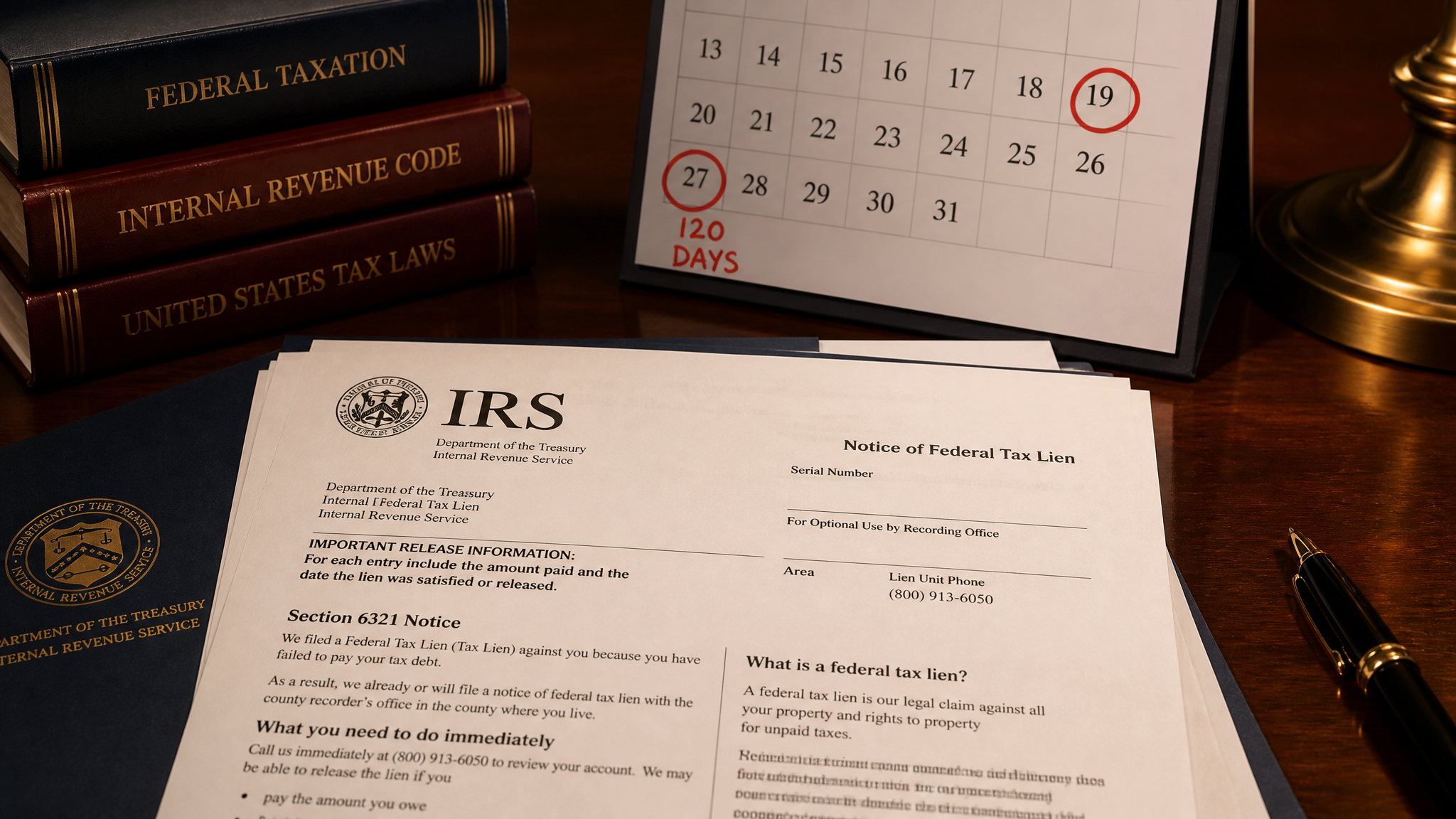
What Is the IRS 120-Day Redemption Right?
When a property with a federal tax lien is sold at a tax deed auction, the IRS does not lose its claim automatically. Under 26 U.S.C. §7425(d) and the Internal Revenue Manual (IRM 5.10.3), the federal government retains a 120-calendar-day right of redemption after the sale.
Where it applies, this means the IRS can step in within 120 days of the sale, pay the buyer the amount paid (plus certain allowable expenses), and redeem the property. Whether the IRS has this right at all — and for how long — depends on the specifics: whether the sale was judicial or nonjudicial, whether the IRS received the notice the statute requires, the priority of the federal lien relative to the tax lien, and any longer redemption period your state law provides. Confirm the federal-lien and notice posture for your specific sale rather than assuming the 120-day rule always applies.
The 120-day clock starts on the date of the tax deed sale, not the date the deed is recorded.
When Does the IRS Redemption Right Apply?
The redemption right applies when:
- The IRS had a filed federal tax lien against the property owner before the tax sale
- The property was sold at a tax sale (judicial or non-judicial)
- The IRS received proper notice of the sale (at least 25 days before the sale date)
Notice to the IRS
This is a critical detail. Under 26 U.S.C. §7425(b), the IRS must receive written notice of the tax sale at least 25 days before the sale date. The notice must be sent to the appropriate IRS office (typically the IRS Advisory Group Manager for the area where the property is located).
Important: If the IRS did not receive proper notice, the federal tax lien may survive the sale entirely — meaning you buy the property subject to the full IRS lien. This is far worse than the 120-day redemption scenario.
Always verify that the IRS was properly notified as part of your pre-bid due diligence. Review the tax suit (in judicial states) or notice records (in non-judicial states) to confirm.
How to Search for Federal Tax Liens
Before bidding on any tax deed property, search for federal tax liens against the current and recent prior owners. Here is how:
County Records
The IRS files Notices of Federal Tax Lien in the county where the property is located. Search the county recorder or clerk's records under:
- The current property owner's name
- Any prior owners from the last 10 years
- Any business entities associated with the owner
PACER (Public Access to Court Electronic Records)
Search PACER (pacer.gov) for any federal court actions involving the property owner. This can reveal:
- Tax court cases
- Federal judgments
- Bankruptcy filings (which interact with tax liens in complex ways)
IRS Lien Status
If you find a federal tax lien, you can request a lien payoff amount from the IRS using Form 14135 or by contacting the IRS Centralized Lien Operation at (800) 913-6050. However, response times can be slow — do this well before auction day.
What Happens If the IRS Redeems
If the IRS exercises its 120-day redemption right:
- The IRS pays you the amount you paid at the auction plus interest at the applicable federal rate
- The IRS also reimburses you for necessary expenses you incurred (e.g., recording fees, property taxes paid)
- You do not get reimbursed for improvements — do not invest in renovations during the 120-day window
- The property transfers to the United States government
- The government typically sells the property to recover the tax debt
In practice, IRS redemptions are relatively rare. The IRS exercises this right selectively, typically when the property value significantly exceeds the auction price plus the tax debt. But "relatively rare" is cold comfort when it happens to your deal.
How Federal Tax Liens Interact With Tax Deed Sales by State
The interaction between IRS liens and tax deed sales varies by state:
Judicial Tax Sale States (e.g., Texas, Ohio)
In states where tax sales are conducted through court proceedings, the IRS is typically named as a party to the lawsuit. If properly served, the federal tax lien is generally extinguished by the judicial sale — but the 120-day redemption right still applies.
Non-Judicial Tax Sale States (e.g., Florida, Georgia)
In states where tax sales happen without court involvement, the situation is more complex:
- If the IRS received proper 25-day advance notice, the sale extinguishes the lien but the 120-day redemption right applies
- If the IRS did not receive proper notice, the lien survives the sale entirely — meaning the new owner takes the property subject to the full IRS debt
This is why verifying IRS notice is critical in non-judicial states.
Protecting Your Investment
Here are the practical steps to protect yourself from IRS-related risks:
Before the Auction
- Search for federal tax liens against the current and recent owners in county records and PACER
- If a lien exists, determine the amount and assess whether the property is still worth pursuing at your maximum bid minus the risk premium
- Verify IRS notice — confirm the taxing authority provided proper 25-day advance notice to the IRS
- Factor in the 120-day holding period — you cannot make improvements or sell during this window
After the Auction
- Do not invest in improvements during the 120-day period — if the IRS redeems, you lose those costs
- Do not sell or contract to sell during the 120-day period — the buyer could lose the property
- Monitor the mail — the IRS will send notice if they intend to redeem
- Keep records of all expenses — recording fees, taxes paid, insurance, and basic maintenance costs are reimbursable if the IRS redeems
After 120 Days
Once the 120-day window closes without IRS action:
- The federal tax lien is extinguished (assuming proper notice was given)
- You can proceed with improvements, sale, or refinancing
- Pursue a quiet title action to confirm clear title
How to Factor IRS Risk Into Your Maximum Bid
If a federal tax lien exists on the property, adjust your maximum bid formula:
Standard Maximum Bid = ARV × Target % − Repairs − Liens − Quiet Title − Holding Costs
IRS-Adjusted Maximum Bid = Standard Maximum Bid − (6 months additional holding costs for the 120-day wait + quiet title delay)
The 120-day period adds approximately 4 months of carrying costs (taxes, insurance, basic maintenance) where you cannot generate income from the property. Some investors simply pass on IRS-liened properties entirely — there are enough opportunities without this added complexity.
Key Takeaways
- The IRS has a 120-day right of redemption on tax deed properties where a federal tax lien existed
- If the IRS was not properly notified of the sale, the lien may survive entirely — much worse than redemption
- Search for federal tax liens in county records and PACER before every bid
- Never invest in improvements during the 120-day window
- IRS redemptions are rare but real — factor the risk into your bidding strategy
- The safest approach: identify IRS-liened properties early and either pass or bid low enough to cover the added risk
Sources & Primary References
Legal statements in this article are grounded in the primary sources below. Statutes and agency rules change — always confirm the current text with the official source and, for a specific property, consult a licensed attorney or title professional.
- 26 U.S.C. § 7425 (Discharge / Redemption of Federal Tax Liens)
- 26 U.S.C. § 6335 (Sale of Seized Property)
- IRS — Understanding a Federal Tax Lien
Reviewed by James K. Quigg. Spotted an error? Report it here.
Last reviewed August 9, 2026Free 7-Document Due Diligence Bundle
Get the printable checklists, worksheets, and reference guides mentioned in this article — completely free.
Want the Complete System?
This article covers one piece of the puzzle. The book gives you the entire due diligence system — 163 pages of practical due diligence guidance.
Get the Book